A poet, a storyteller, a novelist, an essayist and an aphorist,
Veselin Lari Mišnić announced his arrival to
the former Yugoslav literature as an eighteen year old with
his book of poems „Magical Charms“.
With his first work Mišnić implied that he himself
was the poet of unquestional talent and skill, he suggestively
showed that he had the mark of rare and authentic protégés
of muses and the alchemists of words. Later on, the books
with more shapely poetic intesity and maturity followed,
like a springboard leading into a literary existance: „Sick
Chameleon“ (1981.), „Memories from the Cage“ (1982.), „The
Drawer of Circles“ (1983.). With his collection of
short stories „Legends about Insanity“ (1987.)
Mišnić indentified himself as an outstanding
author of fictional prose who could brilliantly utilize inheritence
of national wisdom, synthesize it successfully and build
it up with his lavish and literary disciplined imagination.
With his novel
„Sculptor Gabriel's Illness“ (1989.) the author
proved himself to be one of significant narrators of longer
literary form and with this work he established himself as
an inevitable donor to the pantheon of novelists on who the
Serbian literature should count. With his short but powerful
and striking novel of fictional narrative content „Abyss“(1992.),
as well as with his collection of fictional short-stories „Three
Young Men in a Red-Hot Furnace“ (1993.), Mišnić as
a connoisseur of magical regions of shadows, mirrors of life,
and infinite yearning, marked himself as an author whom no
one of choosy anthologists of Serbian phantasmagoria couldn't
overlook, even if he/she wanted to. Afterwards, with his
collections of poems „To Her Midnight Executioners“ (1989.)
and „Gods and Rats“ (1992.), as well as with
his latest „Shots from the Bottom of the Hearth“ (2001.)
the poet indelibly formed the way of his lyrical understaning
of dreams and ascents and for an octave higher he emphasized
his distinguishable voice among the best poets of this region.
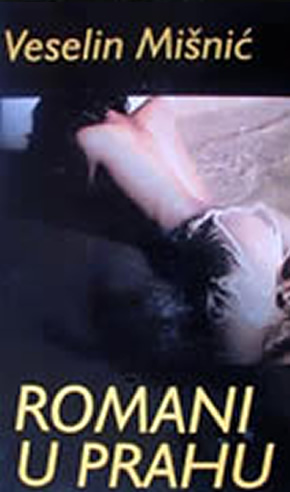
In his most thorough and for our literature capital work,
a trilogy „Novels in Dust“ (1997,1998,1999.),
which had several editions, he told a saga about human unexpected
intertwined destinies, great loves, and suffering; the world
of Marquez is depicted, the one from hundred years of solitude,
the world that exists no more, because we are carrying it
in ourselves like God's greatest gift, but we also carry
it away forever to the realm of dreams and memories.
Three great novels each one about 200 pages long and 51
novels in dust made, in conceptual sense, this book unique,
modern and original creation, which is by its form and content
step out of all known writerly cliches and continued its
way from one into another millennium. Mišnić with
this marvelous book only added one more diamond to his literary
creative diadem and showed that this particular work could
not be easily bounded by the chains of literary principles
and the principles of genre.
The book of aphorisms „Cherries in the colour of Rotten
Sour Cherry“ (1999.), „Galapagos Turtles“ (2000.)
had undeniably proclaimed the basic circle of Mišnić's
creative diversity and introduced him as an excellent satirist
of a rarely strong and sarcastic-ironical breed on whose
reflections could count on not only compilers of aphoristic
anthologies but also the carvers of mind into those eternal
blocks of granite and albums of spirit.
Afterwards „The Face of God, the Hearth of God“ (2002.)
it can be said to be a bit unexpected piece, but the person
who followed the work of this universal author couldn't be
taken by surprise, because each and every of his new creations
is a surprise in itself. This collection of philosophic anthropological
essays was somewhat intoned by Sioran, (Short Display of
Decay), by Dučić (Emperor Radovan's Treasure and
i The Letters from Leutar) and Andrić (Signs by the
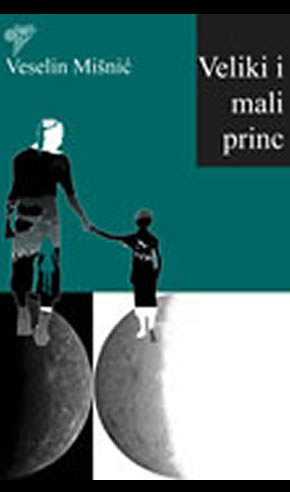
Road). His latest novel „The Big and the Little Prince“(2003.)
the novel of return of the “little prince”
in an amazing way revived this Exupéry's eternal story
a century later.
The spirit of the well-known tale about “The Little
Prince” was again realized in this novel but in one
new and original way in which we could recognize Mišnić's
philosophy of life. And finally, in the end, or in the beginning,
who could tell when we deal with this particular author the
novel „Sadistic Design“ (2004., 2005.) story
about passions and dreams of generations who while thinking
to live in a fairy tale predicted that the fairy tale was
“bloody” and in the moment of waking up realized
that they all were, without exception, attached to life sustaining
devices and that the beauty appeared in dreams, while everything
was different in reality.
It is hard to believe that one could go further in the
realm of fictional writing, except the possible acknowledgement
of vertical spiritual ascension which very few authors of
Mišnić's generation could pride on.
For the critics who focus their view on artistic creation
of Veselin Lari Mišnić it must be somewhat surprising
the fact that this author continually achieves advancement,
ratifies them over and over again, and constantly indentifies
himself in the literature of his time which was and today
is ominously contaminated with ephemeral literary styles
and the other, entirely unrefined syndromes.
Literary devotees, its interpreters strict historians from
near and distant future would have to place Mišnić among
the elite literary authors after World War II, while at the
same time into the tumultuous 20th century. Surely, this
course continued in this century, the century of new hopes
and new beginnings.
It is obvious that one cannot avoid or overlook the thing
which loudly states Mišnić's tall writerly figure
of a modern Serbian literature and his unusual voice is permanently
present in the hearing and lives of many followers of linguistic
art. Yugoslav, and nowadays anthologies of poetry in Serbia
and Montenegro, narrative prose, aphorisms and narrower,
first-class choice of novels could hardly be pictured without
his work and every exclusion would only cause damage to the
criterion of anthologists themselves and editors.
Motive foundation of Mišnić's poetic as well
as prose creative work is the power of love, its energy,
just like the thematic outline of his prose work is fluid
originator of life, while heroes are individualized only
in relation to the energy quantum which they posses within
themselves. Archetypal pictures, universals of imagination
and mind, raging passions strong as a storm, inner darkness
and the fire of the universe in a man's soul, they all are,
in fact, main characters of entire Mišnić's work.
That gallery is impressively rich and suggestively depicted.
Mišnić is a skilled master of illustrating
the areas of a human soul ant those are landscapes which
interest him, and he paints them with all the colours he
can using the palette of human sense and nonsense. That is
how in his poetics exist love and hate at the same time as
an important slope of human soul, that is why there are so
many life juices, abundant overflow, and yet a lot of sandy
deserts, too. The solver of labyrinths of life's secrets,
Mišnić never recommends surrender, but existence,
always a new start into the adventure of meaning, although
he knows that the meaning itself doesn't exist if we don't
make it ourselves.
That is why Veselin Mišnić is the creator of
sense in the realm of artistic illusions, because the beauty
in art exists, like Schopenhauer used to say, to endure the
ugliness of life easier. Art is the anesthetic for painful
reality and Mišnić through his work makes life
easier by injecting new pictures of unique beauty and authentic
artistic strength over and over again. That is the vitality
of his and every other real art which through its beauty
saves the world. While there is an inclination for that kind
of liberating efforts and while there are artists like Mišnić,
the world won't be destroyed.
Jovica Stojanović